Zinc oxide plays a key role in tire manufacturing as an activator in the vulcanization process. Dr. Zinc explains how ZnO contributes to rubber cross-linking, UV resistance and heat dissipation, and why particle size, purity and consistency matter.
The science working inside every tire
Every time a tire grips the road, it is relying on the result of a precise chemical transformation.
Raw rubber starts out soft, tacky, temperature-sensitive and structurally weak. Through vulcanization, its long polymer chains are chemically cross-linked with sulfur, creating a three-dimensional network that gives the finished rubber its strength, elasticity and resistance to heat and wear.
At the heart of that process is a compound most drivers will never see: zinc oxide (ZnO).
In this second episode of Ask Dr. Zinc, we take a closer look at the role zinc oxide plays in tire manufacturing, how it contributes to the vulcanization process and why its particle size, purity and consistency matter to rubber and tire manufacturers.
What does vulcanization do to rubber?
Natural or synthetic raw rubber on its own does not have the properties required of an engineering material used in tires.
Vulcanization changes that.
During the process, long polymer chains in the rubber are chemically cross-linked with sulfur. The resulting three-dimensional network provides the finished rubber with the strength, elasticity, heat resistance and wear resistance required for demanding applications.
Sulfur cross-linking, however, does not happen efficiently on its own.
That is where zinc oxide comes in.
What role does zinc oxide play in vulcanization?
Zinc oxide acts as an activator in the vulcanization system.
It is typically used together with a fatty acid, most commonly stearic acid, and an accelerator. Together, these components help make sulfur cross-linking faster, more efficient and more controlled.
“Zinc oxide acts as an activator in the vulcanization system, helping speed up and control the rate of cross-link formation.”
— Dr. Zinc
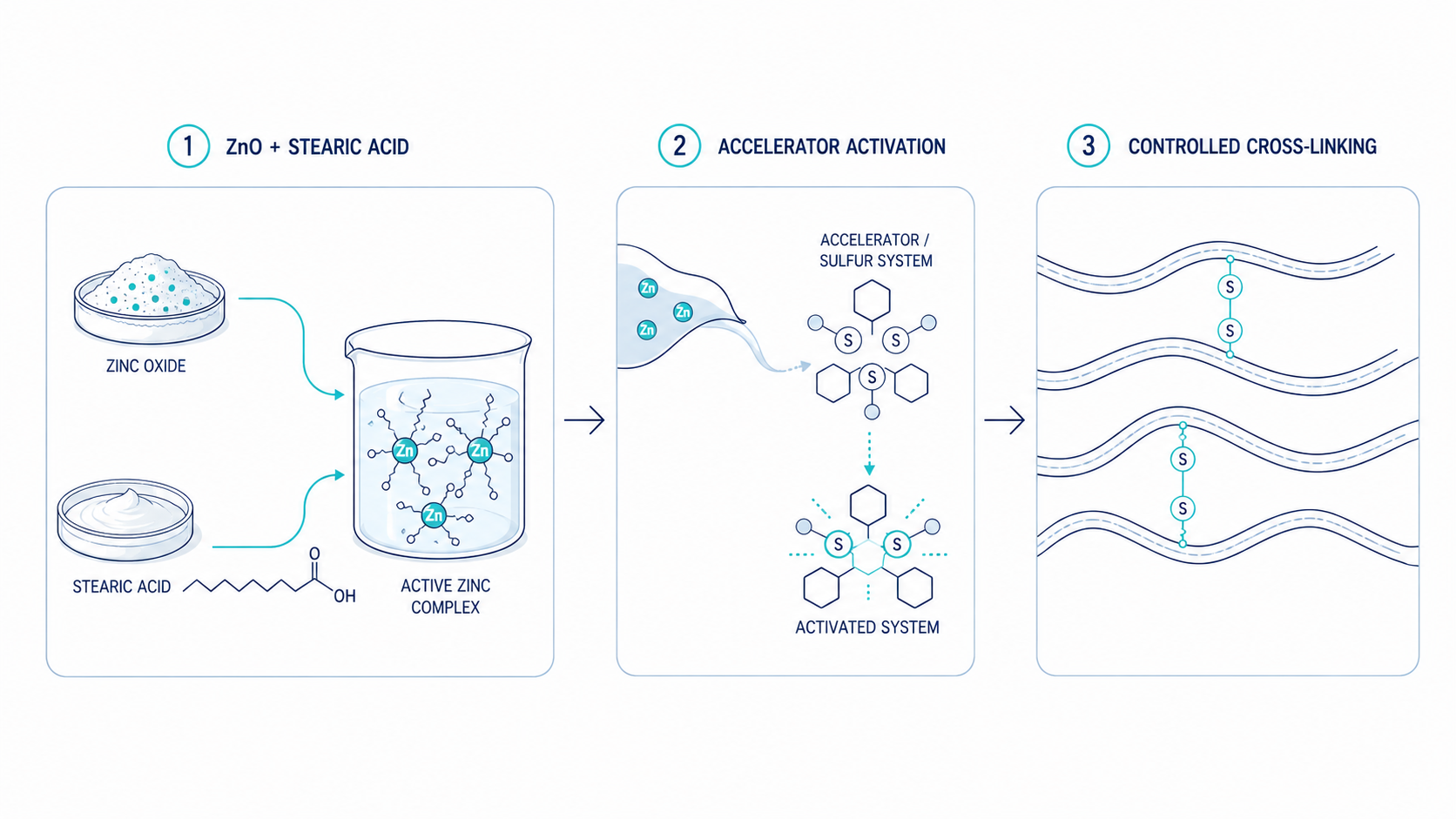
The mechanism can be understood in three main stages.
1. Forming the active complex
Zinc oxide reacts with stearic acid to form zinc stearate, which is soluble in the rubber matrix.
This solubility is important because it allows the zinc-containing species to interact more uniformly throughout the rubber compound. Zinc oxide on its own is insoluble and would therefore be considerably less effective.
2. Activating the accelerator
The zinc complex then reacts with the sulfur accelerator, forming an active sulfurating agent.
This helps speed up and control the rate at which cross-links form between the rubber polymer chains.
3. Optimizing cross-link density
By helping regulate the cross-linking reaction, zinc oxide contributes to determining both the number of cross-links that form and how they are distributed throughout the rubber.
That directly influences important final rubber properties including modulus, elasticity and fatigue resistance.
Without proper zinc oxide activation, vulcanization is slower and less efficient, and the resulting rubber has inferior mechanical properties.
The technical information provided for this Ask Dr. Zinc edition indicates that tires cured without proper zinc oxide activation can wear out three to four times faster than tires manufactured with it.
For tire applications, that difference has implications for cost, safety and sustainability.
Beyond vulcanization: UV resistance and heat dissipation
Zinc oxide continues to contribute to tire performance after curing is complete.
As a semiconductor compound with strong UV absorption properties, ZnO contributes to the rubber’s resistance to UV-induced degradation.
This helps tire sidewalls resist cracking and surface oxidation caused by prolonged exposure to sunlight. In combination with antioxidants and antiozonants, zinc oxide therefore plays a supporting role in extending tire service life beyond the vulcanization stage itself.
ZnO also contributes to heat dissipation within the rubber compound.
Tires generate significant internal heat through repeated flexing under load. Effective thermal management is therefore important in limiting premature degradation of the rubber structure, particularly in high-performance and heavy-duty tire applications.
Why do zinc oxide grade and purity matter in tire manufacturing?
Not all zinc oxide performs in the same way in rubber compounding.
Particle size, surface area and purity all influence how efficiently zinc oxide reacts within the vulcanization system.
For this reason, rubber-grade zinc oxide is manufactured to tighter specifications than zinc oxide intended for other applications.
Three characteristics are particularly important:
- Consistent reactivity from batch to batch, helping cure times and mechanical properties remain predictable ;
- High purity, limiting impurities that could interfere with vulcanization chemistry or compromise rubber performance ;
- Controlled particle size distribution, supporting dispersion quality and the uniformity of cross-linking throughout the rubber compound.
For tire manufacturers, this consistency is a production requirement.
Variability in activator performance can lead to variability in cure time, tensile strength and abrasion resistance across production runs, with direct implications for quality control and safety compliance.

More than a century of zinc oxide in rubber chemistry
The chemistry behind modern tires has a long history.
Charles Goodyear’s discovery of vulcanization in 1839 laid the foundation for the modern rubber industry.
Zinc oxide subsequently became part of that story with the development of accelerated vulcanization systems and has played a role in rubber chemistry for well over a century.
Its continued use reflects how fundamentally suited zinc oxide is to this chemistry.
EverZinc zinc oxide for rubber and tire applications
At EverZinc, we produce activator-grade zinc oxide engineered specifically for rubber and tire applications.
Our zinc oxide is manufactured with the particle size control, purity and batch-to-batch consistency that vulcanization chemistry requires.
It supports tire manufacturers across the value chain, from passenger vehicle tires to heavy-duty industrial applications, helping rubber compounds perform as engineered.
Through the Ask Dr. Zinc series, EverZinc makes the science behind zinc-based materials easier to understand and connects their technical properties with the industrial applications in which they perform.
FAQ: zinc oxide and tire manufacturing
At EverZinc, we produce activator-grade zinc oxide engineered specifically for rubber and tire applications.
Our zinc oxide is manufactured with the particle size control, purity and batch-to-batch consistency that vulcanization chemistry requires.
It supports tire manufacturers across the value chain, from passenger vehicle tires to heavy-duty industrial applications, helping rubber compounds perform as engineered.
Through the Ask Dr. Zinc series, EverZinc makes the science behind zinc-based materials easier to understand and connects their technical properties with the industrial applications in which they perform.
Zinc oxide reacts with stearic acid to form soluble zinc stearate. The resulting zinc complex then reacts with the sulfur accelerator to form an active sulfurating agent, helping speed up and control cross-link formation in the rubber compound.
By helping regulate cross-link formation and distribution, zinc oxide contributes to the rubber’s final modulus, elasticity and fatigue resistance.
Without proper zinc oxide activation, vulcanization is slower and less efficient and produces rubber with inferior mechanical properties. The technical information for this article indicates that tires cured without proper zinc oxide activation can wear out three to four times faster than those manufactured with it.
Yes. Zinc oxide has strong UV absorption properties and contributes to the rubber’s resistance to UV-induced degradation, helping tire sidewalls resist cracking and surface oxidation associated with prolonged sun exposure.
Yes. Zinc oxide contributes to heat dissipation within the rubber compound. This is relevant because tires generate internal heat through repeated flexing under load, particularly in high-performance and heavy-duty applications.
Particle size, surface area and purity affect how efficiently zinc oxide reacts within the vulcanization system. Controlled particle size distribution supports dispersion and uniform cross-linking, while high purity limits impurities that could interfere with vulcanization chemistry.
EverZinc produces activator-grade zinc oxide engineered specifically for rubber and tire applications, with controlled particle size, high purity and batch-to-batch consistency.
What should Dr. Zinc explain next?
This episode explored how zinc oxide contributes to vulcanization, UV resistance and heat dissipation in tire applications, as well as why particle size, purity and consistency matter in rubber compounding.
Have a question about zinc oxide, zinc powder or another industrial application?
Submit your question to Dr. Zinc. It may be featured in a future Ask Dr. Zinc Knowledge Series article.